

Kristopher earned his J.D. at the University of Southern California Gould School of Law where he was a member of the Review of Law and Social Justice honors law journal and was awarded several scholastic honors.

In my experience handling concussion cases in Los Angeles, settlements range from $50,000 to $5 million – and in some cases, more.
A straightforward concussion combined with whiplash typically settles at around $200,000, on the lower end. Cases involving post-concussion syndrome, significant lost earning capacity, and strong expert medical evidence can reach $2 million or more.
No two cases are identical, and the figures insurance companies initially offer rarely reflect what a claim is genuinely worth.
What Is a Concussion And Why “Mild TBI” Is Misleading
I want to address something I hear frequently – the idea that a concussion is just a “mild” traumatic brain injury and therefore not serious.
In my experience, that characterisation is misleading and it is language that benefits insurance companies and defense teams, not injured people.
A concussion is an uncomplicated mild traumatic brain injury in clinical terminology. But the word “mild” refers to the classification – not to how the injury feels or how it affects your life.
I have represented clients whose concussions produced headaches, brain fog, nausea, and light sensitivity for two and a half years. I have seen people take six-month leaves of absence from demanding careers. I have watched clients who never fully returned to the person they were before the accident.
If a concussion stops you from working, generates significant medical bills, causes emotional distress, and disrupts your relationships it is not mild. It is a serious injury that deserves serious compensation.
The label attached to it in a clinical classification system has no bearing on what your case is worth.
Click here if you want to read more about the services we provide to people who’ve suffered a traumatic brain injury.
What Are the Symptoms of a Concussion?
Concussion symptoms vary from person to person, and they do not always appear immediately. Some clients feel the full force of their symptoms within hours of an accident. Others notice symptoms developing over days or weeks.
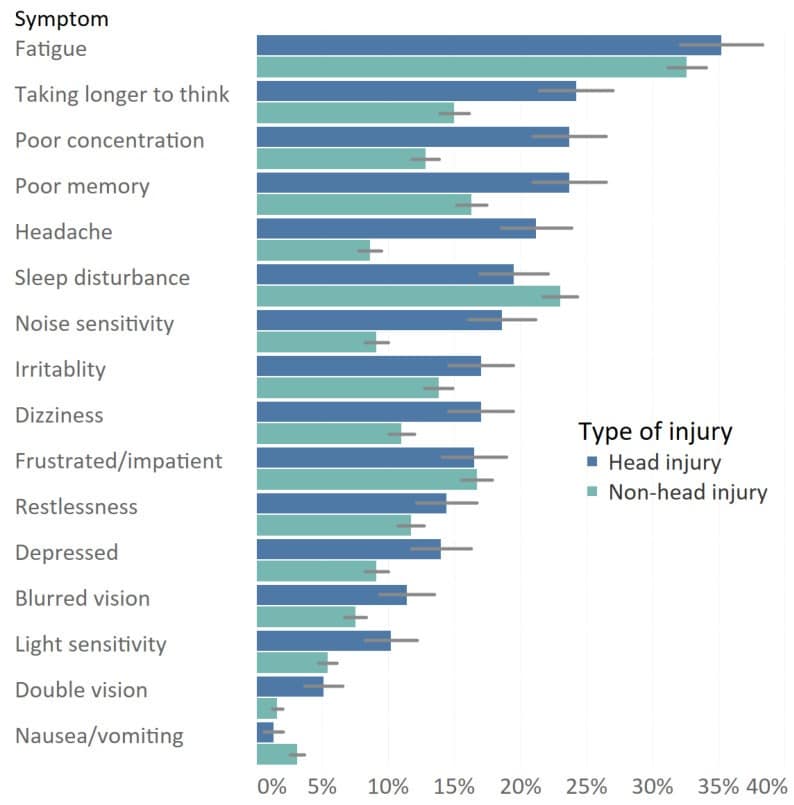
The most common symptoms, as documented in peer-reviewed research published in the Journal of Clinical Medicine, include:
- Fatigue
- Taking longer to think
- Poor concentration
- Poor memory
- Headache
- Sleep disturbance
- Noise sensitivity
- Irritability
- Dizziness
Less common but significant symptoms include blurred vision, light sensitivity, and nausea.
Cognitive symptoms are among the most disruptive.
Difficulty concentrating and memory problems affect work performance directly. They are also among the hardest symptoms to prove – which is why medical documentation from the earliest possible point matters so much.
The following table records the frequency of post-concussion symptoms one year post-injury:
One important point: symptoms can appear days or weeks after the accident.
Do not assume you are uninjured because you feel relatively well at the scene – seek medical evaluation as soon as possible regardless.
How Is a Concussion Diagnosed And Why It Matters for Your Claim
There is no single definitive test for a concussion: a standard 3 Tesla MRI may show nothing – no brain bleed, no haemorrhage, no structural damage. But a clean scan does not mean a clean bill of health.
Diagnosis is based on symptoms, physical examination, neurological assessment, and the circumstances of the accident – a neurologist will evaluate cognitive function, memory, balance, and coordination. In more complex cases, a neuroradiologist and neuropsychologist may also be involved.
For your legal claim, the diagnostic trail matters enormously.
Insurance companies routinely argue that a normal MRI means no real injury. Meanwhile, an experienced attorney knows how to counter that argument – using neuropsychological testing, treating physician records, specialist depositions, and the testimony of expert witnesses who can explain to a jury what a clean scan does and does not tell you.
What Is the Difference Between a Concussion, a Complicated TBI, and a Traumatic Brain Injury?
Not all brain injuries are the same, and the distinction affects both medical treatment and legal strategy.
In my practice, I work across three categories:
- A traumatic brain injury (TBI) in its most serious form involves intracranial haemorrhaging – a brain bleed, a rupture, or a split inside the brain that is objectively verifiable on a standard MRI. A fracture or break to the skull also falls within this category. These are the most severe cases.
- A complicated mild traumatic brain injury involves some structural abnormality on imaging but does not meet the threshold of a full TBI. It sits between the two extremes.
- An uncomplicated mild traumatic brain injury – what most people call a concussion – shows no structural damage on standard imaging. This is the most common category. It is also the category that insurance companies most aggressively attempt to minimise.
The critical point is this: the severity of your injury is not determined by what appears on a scan. It’s determined by how that injury has affected your life – your ability to work, sleep, concentrate, maintain relationships, and function day to day.
| Category | What It Means | Visible on Standard MRI | Typical Settlement Range |
| Traumatic brain injury (TBI) | Intracranial haemorrhage, brain bleed, rupture, or skull fracture | Yes | $1,000,000 – $5,000,000+ |
| Complicated mild TBI | Structural abnormality present but below full TBI threshold | Sometimes | $500,000 – $2,000,000+ |
| Uncomplicated mild TBI (concussion) | No structural damage on standard imaging | No | $50,000 – $2,000,000+ |
What Types of Accidents Cause Concussion Claims in California?
The majority of concussion claims I handle arise from car accidents – rear-end collisions in particular. The sudden deceleration causes the brain to move within the skull and the injury does not require a direct blow to the head.
Beyond car accidents, concussion claims also arise from:
- Slip and fall accidents: Where a fall on a negligently maintained surface causes head impact. These are premises liability claims under California Civil Code Section 1714.
- Assault cases: Including incidents involving bar security or bouncers where excessive force results in head trauma. These cases involve both civil and potentially criminal liability.
- Workplace accidents: Falls from height, falling objects, and equipment failures can all produce concussion injuries.
In every case, the legal framework is the same.
California Civil Code Section 1714 establishes that every person is responsible for injury caused to another by their want of ordinary care or skill. The type of accident determines which legal theory applies – negligence, premises liability, or intentional tort – but the standard of care is consistent across all of them.
What Is the Average Concussion Settlement Amount in California?
Concussion settlements in California – and Los Angeles specifically – do not follow a fixed formula.
Based on my experience and the cases we’ve handled, realistic ranges look like this:
| Injury Type | Estimated Settlement Range |
| Standard concussion, full recovery within weeks | $50,000 – $100,000 |
| Concussion with whiplash, moderate symptoms | $100,000 – $200,000 |
| Concussion with short-term PCS (under 18 months) | $200,000 – $500,000 |
| Concussion with long-term PCS, career impact | $500,000 – $2,000,000+ |
| Concussion with permanent cognitive impairment | $2,000,000 – $5,000,000+ |
These figures reflect cases where liability is clear and medical evidence is strong – a disputed liability case, a policy-limited defendant, or inadequate medical documentation will all suppress these figures. I will address each of those factors below.
I want to flag one figure: the $2 million case I settled for a client in Los Angeles – a Hollywood showrunner rear-ended on the freeway, whose symptoms lasted two and a half years and whose career was fundamentally altered – sits in the upper range of the table above.
That result required strong expert evidence, treating physician records, and a clear documented picture of how the injury changed her professional and personal life.
What Factors Affect the Value of a Concussion Settlement in California?
Several factors determine where in the range above your case falls.
1. Severity and duration of symptoms
A concussion that resolves in six weeks supports a very different claim from one that produces daily headaches, cognitive fog, and emotional dysregulation for two years.
Duration is one of the strongest indicators of value – and it must be backed by consistent medical records throughout.
2. Impact on work and earning capacity.
Can you still do your job? Have you taken time off? Has your performance suffered in ways that are documented by your employer?
Lost earnings and diminished earning capacity are among the most significant economic damages in a concussion case.
3. Medical evidence and expert witnesses
On the larger cases, I work with neurologists, neuroradiologists, and neuropsychologists to build the evidentiary foundation. The treating physician’s records are critical, as is the testimony of expert witnesses who can explain to a jury – in plain terms – why a clean MRI does not mean a clean recovery.
4. The type of accident and liability
Clear liability cases command higher settlements. If comparative fault is in dispute – if the defense argues you contributed to the accident – your recovery may be reduced proportionally.
5. Insurance policy limits
The at-fault party’s coverage imposes a practical ceiling on many settlements. I address this in detail below.
6. The combination of injuries
Concussions rarely present in isolation. Most of my clients also have whiplash, soft tissue injuries, or other orthopaedic injuries. The combination affects both the overall damages picture and the medical narrative.
What Is Post-Concussion Syndrome and How Does It Affect Settlement Value?
Post-concussion syndrome (PCS) is the persistence of concussion symptoms beyond the normal recovery period.
In my experience, approximately 10% of concussion sufferers develop PCS that lasts over a year and a half. Research published in the Journal of Clinical Medicine puts the figure at up to 29.4% among patients with documented head injuries – a higher number that reflects clinical populations who received formal evaluation and diagnosis.
The difference between those two figures matters.
Many people who suffer concussions – particularly in lower-speed accidents – never receive a formal neurological evaluation. They manage their symptoms independently, attribute them to stress or fatigue, and never receive a PCS diagnosis.
The 29.4% figure captures those who entered the medical system. My 10% figure reflects the broader population of concussion sufferers I encounter in practice.
PCS dramatically affects settlement value. The symptoms are persistent and often progressive – headaches, fatigue, cognitive impairment, emotional dysregulation, sleep disturbance, and dizziness that do not resolve with rest or standard treatment.
The impact on work is significant.
The same National Institutes of Health (NIH) study found that only 50.5% of PCS patients returned to work within six months of their injury, compared to 84.2% of those without PCS. Nearly a third of PCS patients – 31.1% – had not returned to work within 12 months, compared to just 4.3% of those without PCS.
Those are not abstract statistics. They translate directly into lost earning capacity claims – one of the largest components of a serious concussion settlement.
Client case: Hollywood showrunner, Los Angeles
My client was a showrunner in the Hollywood television industry – a demanding, high-cognitive-load role. She was rear-ended by a large commercial truck while exiting the freeway. The collision was severe and she was thrown forward and struck the headrest.
Her MRI was clean – no brain bleed, no haemorrhage, no structural abnormality on standard imaging.
What followed was two and a half years of headaches, confusion, nausea, and cognitive fog. She took a six-month leave of absence from her career, saw a therapist and a psychologist.
Medication helped manage the dizziness and headaches but did not restore her to full function. She never fully returned to the person she was before the accident throughout the entire case.
The clean MRI did not define the case. Her symptoms, her documented treatment history, her career impact, and the expert evidence we built around her recovery did.
The case settled for $2 million.
What Do Defense Experts Claim About PCS Duration And What Does the Evidence Actually Show?
This is something I want to address directly, because it comes up in nearly every serious concussion case we handle.
Defense experts routinely argue that post-concussion syndrome resolves within six months. They use this position to limit compensation for ongoing symptoms – arguing that anything beyond six months is attributable to pre-existing conditions, psychological factors, or exaggeration.
The medical literature does not support that position – the evidence puts normal PCS recovery at up to 18 months. Defense experts who cite six months as the standard are drawing on a minority view that serves their client’s interests, not on the weight of the published research.
When I build a PCS case, I use the treating physician records, specialist depositions, and peer-reviewed literature to counter this argument directly. A jury that understands what the evidence actually says about recovery timelines is far less likely to accept a six-month cutoff as reasonable.
How Do California Courts Calculate Concussion Damages?
California law divides compensable damages into two categories – economic and noneconomic. Both apply in concussion cases.
Economic damages are objectively calculable
Under CACI 3903A, a plaintiff may recover the reasonable cost of all past and future medical care that is reasonably necessary as a result of the injury. However, recovery for past medical expenses is limited to the lesser of the amount actually paid or incurred, or the reasonable value of the services.
Under CACI 3903C and 3903D, a plaintiff may recover past and future lost earnings as well as the loss of future earning capacity – encompassing both the specific wages lost and the overall reduction in their ability to earn money over their working life as a result of the injury.
Noneconomic damages are not tied to a specific figure
Under CACI 3905A, a plaintiff may recover for physical pain, mental suffering, loss of enjoyment of life, inconvenience, grief, anxiety, humiliation, and emotional distress.
The California Court of Appeal has confirmed that no fixed standard exists for calculating these damages – the jury uses its judgment based on the evidence and common sense.
As the court stated in Pearl v. City of Los Angeles (2019): “One of the most difficult tasks imposed on a fact finder is to determine the amount of money the plaintiff is to be awarded as compensation for pain and suffering. The inquiry is inherently subjective and not easily amenable to concrete measurement.”
California places no cap on economic or noneconomic damages in standard personal injury cases. This is a critical distinction from medical malpractice claims, which are subject to the Medical Injury Compensation Reform Act’s (MICRA) cap on noneconomic damages.
I have handled cases where the defense attempted to apply MICRA to a personal injury claim – and successfully argued that it did not apply. In car accident cases, premises liability claims, and assault cases, there is no ceiling on what a jury can award.
| Damage Category | Legal Standard | Plain English |
| Past medical expenses | CACI 3903A: Lesser of the amount paid/ incurred or the reasonable market value | Medical bills caused by the accident, capped at what insurance actually paid (not the raw hospital sticker price) |
| Future medical expenses | CACI 3903A: Reasonably certain to be needed in the future; cost must be reasonable | Projected ongoing treatment costs (therapies, specialists, meds) backed by medical expert testimony |
| Past lost earnings | CACI 3903C: Income/ wages actually lost from the date of injury to the date of trial | Actual paycheck wages, salary, or self-employment income missed while recovering |
| Future lost earning capacity | CACI 3903D: The reasonable value of the loss of the ability to earn money in the future | Career earnings and promotional growth lost due to a permanent or long-term impairment |
| Pain and suffering | CACI 3905A: No fixed standard; left to the jury’s reasonable judgment and common sense | The physical pain, cognitive impairment struggles, and overall physical toll of the concussion |
| Loss of enjoyment of life | CACI 3905A: Component of non-economic damages | Inability to pursue pre-accident activities, hobbies, lifestyle, or milestones |
| Emotional distress | CACI 3905A: Component of non-economic damages | Psychological impacts directly tied to the TBI, such as newly onset anxiety, depression, mood changes, or grief |
What Is the Multiplier Method and How Does It Apply to Concussion Cases?
The multiplier method is the most commonly used framework for calculating noneconomic damages in personal injury settlements.
It works by applying a multiplier to the total economic damages – medical expenses plus lost earnings – to arrive at a figure for pain and suffering.
For minor injuries with full recovery, insurers typically apply a multiplier of 1.5 to 2. For serious injuries with lasting consequences, plaintiff attorneys push for multipliers of 3 to 5. In cases involving permanent cognitive impairment or long-term PCS, the multiplier can exceed 5.
In practice, the multiplier is a negotiating framework – not a legal formula. California courts do not instruct juries to apply a multiplier.
What matters in litigation is the quality of the evidence, the credibility of the expert witnesses, and the documented impact of the injury on the plaintiff’s life – a well-built case commands a higher multiplier in settlement negotiations because the alternative, a jury verdict, carries real risk for the insurer.
| Injury Scenario | Typical Multiplier Range | Example: $100,000 Economic Damages |
| Minor concussion, full recovery within weeks | 1.5x – 2x | $150,000 – $200,000 total |
| Moderate concussion with whiplash, partial recovery | 2x – 3x | $200,000 – $300,000 total |
| Concussion with short-term PCS (under 18 months) | 3x – 4x | $300,000 – $400,000 total |
| Concussion with long-term PCS, career impact | 4x – 5x | $400,000 – $500,000 total |
| Permanent cognitive impairment | 5x+ | $500,000+ total |
What Happens If the At-Fault Driver Has Limited Insurance Coverage?
Insurance policy limits are the single most powerful downward force on concussion settlements in California. For example, a victim can have serious, long-lasting injuries and still receive a fraction of their true damages if the at-fault party carries only minimum coverage.
California requires drivers to carry minimum liability coverage of $30,000 per person and $60,000 per accident for bodily injury, alongside $15,000 for property damage, under Vehicle Code Section 16056. In a concussion case worth $500,000, a defendant carrying minimum coverage creates an immediate problem.
The options available to address this include pursuing the plaintiff’s own uninsured/ underinsured motorist (UIM) coverage, identifying additional defendants with deeper insurance coverage, and, in some cases, pursuing assets directly.
An attorney filing a demand letter is typically the first step – most plaintiffs and defendants do not know the defendant’s policy limit until that step is taken.
For a detailed breakdown of how insurance policy limits affect TBI and concussion settlements in California – including real case data – see our analysis here.
How Does California’s Comparative Fault Rule Affect My Concussion Claim?
Under California’s pure comparative fault system – established under case law interpreting Civil Code Section 1714 – a plaintiff’s financial recovery is reduced in proportion to their own percentage of fault. However, they can still recover damages even if they were partially at fault for the accident.
For example, if a jury determines you were 25% responsible for the collision, your damages are reduced by 25% and a $400,000 award becomes $300,000.
Defense teams routinely argue comparative fault to suppress settlement values – it’s one of the most aggressively litigated issues in California personal injury cases. Strong liability evidence from the outset – police reports, witness statements, accident reconstruction, dashcam footage – is the most effective counter to a comparative fault argument.
What Is the Statute of Limitations for a Concussion Claim in California?
In California, you generally have two years from the date of the accident to file a personal injury lawsuit. This deadline is set by California Code of Civil Procedure Section 335.1.
Miss that deadline and you lose your right to compensation – regardless of how strong your case is.
There are two important exceptions:
- If the at-fault party was a government entity – a city bus, a county vehicle, a public agency – you must file an administrative claim within six months of the accident under Government Code Section 911.2, before any lawsuit can be filed. This shorter deadline catches many injured people off guard.
- If the injured person is a minor, the statute of limitations is tolled – paused – until they turn 18, at which point the two-year period begins.
Do not wait.
Concussion cases depend on contemporaneous medical records, preserved accident evidence, and witness accounts that become harder to obtain with time.
Contact a lawyer as soon as possible after the accident.
Click here to read more about how long after an accident you need to file a claim.
| Claimant/ Situation | Deadline | Legal Authority |
| Standard personal injury claim | 2 years from date of accident | CCP §335.1 |
| Claim against a government entity | 6 months from date of accident – administrative claim must be filed first | Gov. Code §911.2 |
| Injured minor | Tolled until age 18, then 2 years from 18th birthday | CCP §352 |
What Steps Should I Take to Protect My Right to Compensation?
The decisions you make in the hours, days, and weeks after a concussion have a direct impact on the value of your legal claim. These are the steps I recommend to every client.
1. Seek medical treatment immediately
Do not wait to see if symptoms improve – a gap between the accident and your first medical evaluation is one of the most commonly exploited weaknesses in concussion claims. Insurance adjusters will argue that the delay means the injury was not serious – or was not caused by the accident at all.
2. Get a police report
If the concussion arose from a car accident, ensure a police report is filed at the scene. This creates an official contemporaneous record of the collision, the parties involved, and the initial circumstances. Do not leave the scene without one.
3. Gather witness information
Names and contact details of anyone who witnessed the accident are valuable. Witness accounts become harder to obtain as time passes.
4. Document your symptoms consistently
Keep a daily journal recording your headaches, cognitive difficulties, sleep disturbances, emotional changes, and any impact on your ability to work. Ask family members and colleagues to note changes they observe in your behaviour and performance. This contemporaneous record is difficult for insurance companies to challenge.
5. Do not accept an early settlement offer
Insurance companies are trained to make early offers before the full extent of a concussion injury is known – a concussion that appears to be resolving may develop into post-concussion syndrome. Cognitive deficits may not be fully apparent until neuropsychological testing is completed.
Accepting an early offer – even one that seems reasonable – may bar you from further compensation once the true scope of your injuries becomes clear.
6. Do not give a recorded statement to the insurance company without legal advice
Anything you say can be used to minimise your claim. Insurance adjusters are experienced at asking questions in ways that produce answers that limit liability. Speak with a lawyer before making any statement.
7. Contact a lawyer early
The earlier you involve experienced legal counsel, the better positioned your case will be – evidence is preserved and expert witnesses are retained. The insurance company’s narrative is challenged before it hardens.
Please don’t hesitate to contact us today!
Peerali Law: Concussion and Catastrophic Injury Claims in California
At Peerali Law, we specialise in complex and catastrophic personal injury cases – including concussion and traumatic brain injury claims where the stakes are high and the insurance company is fighting hard.
I am Kristopher L. Peerali, co-founding partner of Peerali Law. I earned my J.D. from USC Gould School of Law, where I was a member of the Review of Law and Social Justice honours law journal. I have been admitted to the State Bar of California since 2018. My results include a $16.3 million premises liability settlement and a $5.2 million car accident settlement.
You can review our full case results here.
If your concussion is leading to time off work, a lengthy recovery, ongoing symptoms, or medical bills that are mounting – or if you have already been contacted by an insurance company with an offer – I want to hear from you. Early offers rarely reflect the true value of a serious concussion claim.
We handle concussion and traumatic brain injury cases on a no-win, no-fee basis – meaning you pay nothing unless we recover compensation for you.
Full details of our fee structure are available here.
Call us at (818)-477-3997 or request a free case review today.
I Already Have a Lawyer, Can I Still Contact Peerali Law?
Yes. If you are represented by another attorney but feel the settlement being discussed does not reflect the full value of your injuries, you can contact us.
Review your existing agreement carefully – most no-win, no-fee arrangements allow you to exit the contract without penalty, provided you have not already accepted a settlement figure.
If you are unhappy with the direction of your case – or simply want a second opinion on whether the offer on the table is fair – call us at (818)-477-3997. The conversation is free and without obligation.